Golden bulb
glint · Examples · Tutorials · Gallery
The Mandelbulb, heavier: slowly orbiting, coloured by how each point's orbit wandered, soft shadows from the key light, a glow where rays skimmed past, and its power breathing with the music.
Audio-reactive: it moves with music from a microphone, line-in or a file.
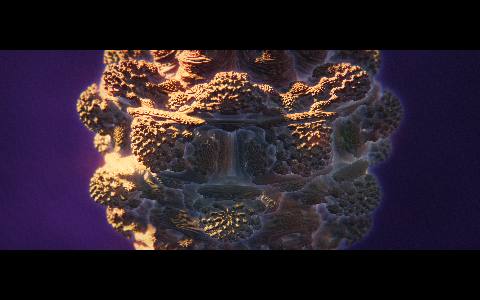
An example in glint, a free live shader editor in the browser: the GLSL code floats over the running picture and recompiles as you type.
The code
3 passes, drawn in this order each frame, in GLSL.
Scene: fragment shader
#version 300 es
precision highp float;

uniform float time;
uniform vec2 resolution;
uniform vec3 spectrum;
uniform float beat;
uniform float beatTime;
uniform int beatCount;
uniform sampler2D fft;
uniform float power;

in vec2 v_texcoord;
out vec4 fragColor;

// 1 on each kick, fading; without audio, a steady pulse twice a second.
float kick() { return beatCount > 0 ? beat : pow(1.0 - fract(time * 2.0), 4.0); }
// Seconds since the last kick, and which kick it was (the same fallback).
float sinceKick() { return beatCount > 0 ? beatTime : fract(time * 2.0) / 2.0; }
float kickId() { return beatCount > 0 ? float(beatCount) : floor(time * 2.0); }
// One FFT bin, 0..1 across the spectrum (bass on the left).
float bin(float x) { return texture(fft, vec2(x, 0.25)).r; }
// Is anything playing? (Examples fake their input when not.)
bool silent() { return spectrum.x + spectrum.y + spectrum.z < 0.0001; }

float hash(float n) { return fract(sin(n * 127.1) * 43758.5453); }
float hash(vec2 p) { return fract(sin(dot(p, vec2(127.1, 311.7))) * 43758.5453); }
vec2 hash2(float n) { return fract(sin(vec2(n * 127.1, n * 269.5)) * 43758.5453); }
mat2 rot(float a) { float c = cos(a), s = sin(a); return mat2(c, s, -s, c); }
vec3 pal(float t) { return 0.5 + 0.5 * cos(6.28318 * (t + vec3(0.0, 0.33, 0.67))); }

float hash13(vec3 p) {
    uvec3 q = uvec3(ivec3(floor(p)) + 1000000) * uvec3(1597334673u, 3812015801u, 2798796415u);
    uint n = (q.x ^ q.y ^ q.z) * 1597334673u;
    return float(n >> 8) / 16777216.0;
}
float hash12(vec2 p) {
    uvec2 q = uvec2(ivec2(floor(p)) + 1000000) * uvec2(1597334673u, 3812015801u);
    uint n = (q.x ^ q.y) * 1597334673u;
    return float(n >> 8) / 16777216.0;
}
float noise3(vec3 p) {
    vec3 i = floor(p), f = fract(p);
    f = f * f * (3.0 - 2.0 * f);
    return mix(mix(mix(hash13(i), hash13(i + vec3(1.0, 0.0, 0.0)), f.x), mix(hash13(i + vec3(0.0, 1.0, 0.0)), hash13(i + vec3(1.0, 1.0, 0.0)), f.x), f.y),
               mix(mix(hash13(i + vec3(0.0, 0.0, 1.0)), hash13(i + vec3(1.0, 0.0, 1.0)), f.x), mix(hash13(i + vec3(0.0, 1.0, 1.0)), hash13(i + vec3(1.0, 1.0, 1.0)), f.x), f.y), f.z);
}
float noise2(vec2 p) {
    vec2 i = floor(p), f = fract(p);
    f = f * f * (3.0 - 2.0 * f);
    return mix(mix(hash12(i), hash12(i + vec2(1.0, 0.0)), f.x), mix(hash12(i + vec2(0.0, 1.0)), hash12(i + vec2(1.0, 1.0)), f.x), f.y);
}
float fbm3(vec3 p, int oct) {
    float s = 0.0, a = 0.5;
    for (int i = 0; i < 8; i++) {
        if (i >= oct) break;
        s += a * noise3(p);
        p = p * 2.02 + vec3(13.1, 7.7, 3.3);
        a *= 0.5;
    }
    return s;
}
float fbm2(vec2 p, int oct) {
    float s = 0.0, a = 0.5;
    mat2 m = mat2(1.6, 1.2, -1.2, 1.6);
    for (int i = 0; i < 10; i++) {
        if (i >= oct) break;
        s += a * noise2(p);
        p = m * p;
        a *= 0.5;
    }
    return s;
}
vec3 look(vec3 ro, vec3 ta, vec2 uv, float zoom) {
    vec3 f = normalize(ta - ro), r = normalize(cross(vec3(0.0, 1.0, 0.0), f)), u = cross(f, r);
    return normalize(uv.x * r + uv.y * u + zoom * f);
}
// Henyey-Greenstein: how much light scatters towards the eye (g > 0: mostly forwards).
float hg(float c, float g) { float g2 = g * g; return (1.0 - g2) / (12.566 * pow(1.0 + g2 - 2.0 * g * c, 1.5)); }
// A starfield on directions: three layers of jittered points, warm to cool.
vec3 starfield(vec3 d) {
    vec3 col = vec3(0.0);
    for (int l = 0; l < 3; l++) {
        float sc = 110.0 + float(l) * 160.0;
        vec3 q = d * sc;
        vec3 id = floor(q);
        float h = hash13(id + float(l) * 37.0);
        if (h > 0.982) {
            vec3 j = vec3(hash13(id + 1.3), hash13(id + 2.7), hash13(id + 5.1)) - 0.5;
            float dd = length(fract(q) - 0.5 - j * 0.6);
            col += mix(vec3(1.0, 0.8, 0.6), vec3(0.6, 0.75, 1.0), hash13(id + 9.0)) * exp(-dd * dd * 60.0) * (h - 0.982) * 90.0;
        }
    }
    return col;
}

float bass, kk;
vec4 trap;

// The Mandelbulb: z -> z^power + c in spherical coordinates, with the running derivative for a distance estimate, and
// the orbit's closest approaches (trap) for colour.
float map(vec3 p) {
    vec3 w = p;
    float m = dot(w, w);
    vec4 tr = vec4(abs(w), m);
    float dz = 1.0;
    float pw = power + 0.6 * sin(time * 0.15) + 0.3 * bass;
    for (int i = 0; i < 6; i++) {
        float r = sqrt(m);
        dz = pw * pow(r, pw - 1.0) * dz + 1.0;
        float th = pw * acos(clamp(w.y / max(r, 1e-6), -1.0, 1.0));
        float ph = pw * atan(w.x, w.z);
        w = p + pow(r, pw) * vec3(sin(th) * sin(ph), cos(th), sin(th) * cos(ph));
        tr = min(tr, vec4(abs(w), m));
        m = dot(w, w);
        if (m > 256.0) break;
    }
    trap = tr;
    return 0.25 * log(m) * sqrt(m) / dz;
}

vec3 normal(vec3 p, float e) {
    vec2 k = vec2(1.0, -1.0);
    return normalize(k.xyy * map(p + k.xyy * e) + k.yyx * map(p + k.yyx * e) + k.yxy * map(p + k.yxy * e) + k.xxx * map(p + k.xxx * e));
}

float softShadow(vec3 ro, vec3 rd) {
    float res = 1.0, t = 0.01;
    for (int i = 0; i < 64; i++) {
        float h = map(ro + rd * t);
        res = min(res, 10.0 * h / t);
        t += clamp(h, 0.003, 0.1);
        if (res < 0.002 || t > 2.5) break;
    }
    return clamp(res, 0.0, 1.0);
}

void main() {
    vec2 uv = (gl_FragCoord.xy - 0.5 * resolution) / resolution.y;
    bass = silent() ? 0.2 + 0.3 * kick() : spectrum.x;
    kk = kick();
    float a = time * 0.1, b = 0.3 + 0.25 * sin(time * 0.07), dist = 3.3 + 0.4 * sin(time * 0.05);
    vec3 ro = dist * vec3(sin(a) * cos(b), sin(b), cos(a) * cos(b));
    vec3 rd = look(ro, vec3(0.0, -0.1, 0.0), uv, 1.6);
    // Background: a dusky gradient and a faint nebula.
    vec3 col = mix(vec3(0.02, 0.015, 0.04), vec3(0.08, 0.05, 0.1), rd.y * 0.5 + 0.5) + vec3(0.25, 0.1, 0.3) * pow(fbm3(rd * 3.0, 4), 3.0) * 0.6;
    float depth = 1.0;
    // Only inside the bounding sphere.
    float bb = dot(ro, rd), cc = dot(ro, ro) - 1.3 * 1.3, disc = bb * bb - cc;
    float glow = 0.0;
    if (disc > 0.0) {
        float t = max(-bb - sqrt(disc), 0.0), tEnd = -bb + sqrt(disc);
        bool hit = false;
        for (int i = 0; i < 220; i++) {
            float h = map(ro + rd * t);
            glow += exp(-h * 60.0) * 0.004;
            if (h < 0.0004 * t) { hit = true; break; }
            t += h;
            if (t > tEnd) break;
        }
        vec3 gcol = mix(vec3(1.0, 0.45, 0.2), vec3(0.4, 0.6, 1.0), 0.5 + 0.5 * sin(time * 0.2));
        if (hit) {
            vec3 p = ro + rd * t;
            vec4 tr = trap;
            vec3 n = normal(p, 0.0004 * t);
            // Colour from the orbit trap: gold, rust and teal.
            vec3 alb = mix(vec3(0.95, 0.7, 0.35), vec3(0.75, 0.25, 0.12), clamp(tr.y * 1.5, 0.0, 1.0));
            alb = mix(alb, vec3(0.1, 0.45, 0.5), clamp(tr.w * tr.w * 0.12, 0.0, 0.5));
            alb *= 0.6;
            // Ambient occlusion from the orbit (deep crevices trap close to the centre).
            float occ = clamp(0.05 * log(tr.w), 0.0, 1.0);
            occ = mix(occ, 1.0, 0.3);
            vec3 key = normalize(vec3(0.6, 0.7, -0.4));
            float sh = softShadow(p + n * 0.002, key);
            float dif = max(dot(n, key), 0.0) * sh;
            float sky = 0.5 + 0.5 * n.y;
            float back = max(dot(n, -key * vec3(1.0, 0.0, 1.0)), 0.0);
            float fre = pow(1.0 - max(dot(n, -rd), 0.0), 3.0);
            vec3 lin = vec3(1.4, 1.1, 0.85) * dif * (2.4 + 1.5 * kk) + vec3(0.25, 0.35, 0.6) * sky * occ * 1.4 + vec3(0.4, 0.25, 0.2) * back * occ + gcol * fre * occ * 0.6;
            col = alb * lin;
            col += vec3(1.0, 0.9, 0.7) * pow(max(dot(n, normalize(key - rd)), 0.0), 40.0) * sh * 1.5;
            depth = t / 5.0;
        }
        col += gcol * glow * (0.6 + 1.5 * bass);
    }
    fragColor = vec4(col, depth);
}
Bloom: fragment shader
#version 300 es
precision highp float;

uniform sampler2D pass0;
uniform vec2 resolution;

in vec2 v_texcoord;
out vec4 fragColor;

// Glow: only what's brighter than white, gathered on a golden-angle spiral at two sizes (a tight core, a wide haze).
void main() {
    vec2 st = gl_FragCoord.xy / resolution;
    vec2 aspect = vec2(resolution.y / resolution.x, 1.0);
    vec3 tight = vec3(0.0), wide = vec3(0.0);
    for (int i = 0; i < 64; i++) {
        float fi = float(i) + 0.5;
        vec2 dir = vec2(cos(fi * 2.39996), sin(fi * 2.39996)) * sqrt(fi / 64.0) * aspect;
        tight += max(texture(pass0, st + dir * 0.03).rgb - 1.0, 0.0);
        wide += max(texture(pass0, st + dir * 0.12).rgb - 1.0, 0.0);
    }
    fragColor = vec4((tight * 0.6 + wide * 0.4) / 64.0, 1.0);
}
Lens: fragment shader
#version 300 es
precision highp float;

uniform sampler2D pass0;
uniform sampler2D pass1;
uniform vec2 resolution;
uniform float time;
uniform float exposure;
uniform float aperture;

in vec2 v_texcoord;
out vec4 fragColor;

float hash(float n) { return fract(sin(n * 127.1) * 43758.5453); }
float hash(vec2 p) { return fract(sin(dot(p, vec2(127.1, 311.7))) * 43758.5453); }
vec2 hash2(float n) { return fract(sin(vec2(n * 127.1, n * 269.5)) * 43758.5453); }
mat2 rot(float a) { float c = cos(a), s = sin(a); return mat2(c, s, -s, c); }
vec3 pal(float t) { return 0.5 + 0.5 * cos(6.28318 * (t + vec3(0.0, 0.33, 0.67))); }

vec3 aces(vec3 x) { return clamp((x * (2.51 * x + 0.03)) / (x * (2.43 * x + 0.59) + 0.14), 0.0, 1.0); }

void main() {
    vec2 st = gl_FragCoord.xy / resolution;
    vec2 aspect = vec2(resolution.y / resolution.x, 1.0);
    // Cinema bars.
    float bars = abs(st.y - 0.5) * 2.0;
    if (bars > resolution.x / resolution.y / 2.39 * 1.0 && resolution.x > resolution.y) { fragColor = vec4(0.0, 0.0, 0.0, 1.0); return; }

    // Depth of field, focused on whatever's in the middle of the frame (it's usually the orb).
    float focus = texture(pass0, vec2(0.5)).a;
    float depth = texture(pass0, st).a;
    float blur = clamp(abs(depth - focus) / max(depth, 0.01) * 0.005 * aperture, 0.0, 0.008);
    // Chromatic aberration: red and blue land a little apart towards the edges.
    vec2 fromCentre = st - 0.5;
    float ca = 0.004 * dot(fromCentre, fromCentre) * 4.0;
    vec3 col = vec3(0.0);
    float total = 0.0;
    for (int i = 0; i < 48; i++) {
        float fi = float(i) + 0.5;
        vec2 o = vec2(cos(fi * 2.39996), sin(fi * 2.39996)) * sqrt(fi / 48.0) * blur * aspect * 2.0;
        // Don't let sharp foreground bleed into the blur behind it: weight by the sample's own blur.
        vec4 c = texture(pass0, st + o);
        float w = clamp(abs(c.a - focus) / max(c.a, 0.01) * 0.005 * aperture / max(blur, 0.0005), 0.2, 1.0);
        col += vec3(texture(pass0, st + o + fromCentre * ca).r, c.g, texture(pass0, st + o - fromCentre * ca).b) * w;
        total += w;
    }
    col /= total;

    // Bloom, a horizontal streak (anamorphic lens), and ghosts mirrored through the middle (lens flare).
    vec3 bloom = texture(pass1, st).rgb;
    vec3 streak = vec3(0.0);
    for (int i = -12; i <= 12; i++) streak += texture(pass1, st + vec2(float(i) * 0.02, 0.0)).rgb * exp(-abs(float(i)) * 0.2);
    vec3 ghosts = vec3(0.0);
    for (int k = 1; k <= 3; k++) ghosts += texture(pass1, 0.5 - fromCentre * (0.5 + float(k) * 0.35)).rgb * pal(float(k) * 0.3) * 0.25;
    col += bloom * 0.7 + streak * vec3(0.3, 0.5, 1.0) * 0.06 + ghosts * 0.6;

    col = aces(col * exposure);
    col = pow(col, vec3(0.4545));
    // Grade: more contrast and colour, cool shadows and warm highlights (the film look).
    float luma = dot(col, vec3(0.2126, 0.7152, 0.0722));
    col = mix(vec3(luma), col, 1.25);
    col = mix(col, col * col * (3.0 - 2.0 * col), 0.6);
    col *= mix(vec3(0.85, 1.0, 1.1), vec3(1.1, 1.0, 0.85), smoothstep(0.1, 0.7, luma));
    col *= 1.0 - 0.35 * dot(fromCentre, fromCentre) * 2.5;                               // vignette
    col += (hash(gl_FragCoord.xy + fract(time) * 713.0) - 0.5) * 0.035;               // film grain
    fragColor = vec4(col, 1.0);
}
More Showpieces examples
Sanctum · Open ocean · Cumulus · Event horizon · Storm sea · Crystal caves · Nebula