Event horizon
glint · Examples · Tutorials · Gallery
A black hole bending light: every ray is integrated step by step round it, so the far side of the accretion disk shows above and below the shadow, with the photon ring at its edge. The disk turns faster inside, is brighter on the side coming at you, and burns hotter with the bass.
Audio-reactive: it moves with music from a microphone, line-in or a file.
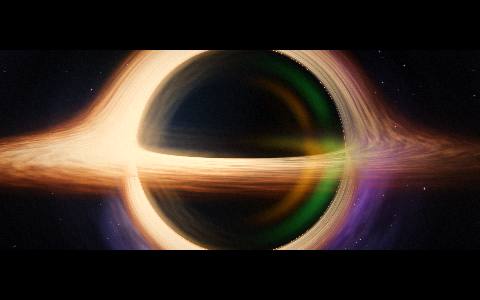
An example in glint, a free live shader editor in the browser: the GLSL code floats over the running picture and recompiles as you type.
The code
3 passes, drawn in this order each frame, in GLSL.
Scene: fragment shader
#version 300 es
precision highp float;

uniform float time;
uniform vec2 resolution;
uniform vec3 spectrum;
uniform float beat;
uniform float beatTime;
uniform int beatCount;
uniform sampler2D fft;
uniform float disk;

in vec2 v_texcoord;
out vec4 fragColor;

// 1 on each kick, fading; without audio, a steady pulse twice a second.
float kick() { return beatCount > 0 ? beat : pow(1.0 - fract(time * 2.0), 4.0); }
// Seconds since the last kick, and which kick it was (the same fallback).
float sinceKick() { return beatCount > 0 ? beatTime : fract(time * 2.0) / 2.0; }
float kickId() { return beatCount > 0 ? float(beatCount) : floor(time * 2.0); }
// One FFT bin, 0..1 across the spectrum (bass on the left).
float bin(float x) { return texture(fft, vec2(x, 0.25)).r; }
// Is anything playing? (Examples fake their input when not.)
bool silent() { return spectrum.x + spectrum.y + spectrum.z < 0.0001; }

float hash(float n) { return fract(sin(n * 127.1) * 43758.5453); }
float hash(vec2 p) { return fract(sin(dot(p, vec2(127.1, 311.7))) * 43758.5453); }
vec2 hash2(float n) { return fract(sin(vec2(n * 127.1, n * 269.5)) * 43758.5453); }
mat2 rot(float a) { float c = cos(a), s = sin(a); return mat2(c, s, -s, c); }
vec3 pal(float t) { return 0.5 + 0.5 * cos(6.28318 * (t + vec3(0.0, 0.33, 0.67))); }

float hash13(vec3 p) {
    uvec3 q = uvec3(ivec3(floor(p)) + 1000000) * uvec3(1597334673u, 3812015801u, 2798796415u);
    uint n = (q.x ^ q.y ^ q.z) * 1597334673u;
    return float(n >> 8) / 16777216.0;
}
float hash12(vec2 p) {
    uvec2 q = uvec2(ivec2(floor(p)) + 1000000) * uvec2(1597334673u, 3812015801u);
    uint n = (q.x ^ q.y) * 1597334673u;
    return float(n >> 8) / 16777216.0;
}
float noise3(vec3 p) {
    vec3 i = floor(p), f = fract(p);
    f = f * f * (3.0 - 2.0 * f);
    return mix(mix(mix(hash13(i), hash13(i + vec3(1.0, 0.0, 0.0)), f.x), mix(hash13(i + vec3(0.0, 1.0, 0.0)), hash13(i + vec3(1.0, 1.0, 0.0)), f.x), f.y),
               mix(mix(hash13(i + vec3(0.0, 0.0, 1.0)), hash13(i + vec3(1.0, 0.0, 1.0)), f.x), mix(hash13(i + vec3(0.0, 1.0, 1.0)), hash13(i + vec3(1.0, 1.0, 1.0)), f.x), f.y), f.z);
}
float noise2(vec2 p) {
    vec2 i = floor(p), f = fract(p);
    f = f * f * (3.0 - 2.0 * f);
    return mix(mix(hash12(i), hash12(i + vec2(1.0, 0.0)), f.x), mix(hash12(i + vec2(0.0, 1.0)), hash12(i + vec2(1.0, 1.0)), f.x), f.y);
}
float fbm3(vec3 p, int oct) {
    float s = 0.0, a = 0.5;
    for (int i = 0; i < 8; i++) {
        if (i >= oct) break;
        s += a * noise3(p);
        p = p * 2.02 + vec3(13.1, 7.7, 3.3);
        a *= 0.5;
    }
    return s;
}
float fbm2(vec2 p, int oct) {
    float s = 0.0, a = 0.5;
    mat2 m = mat2(1.6, 1.2, -1.2, 1.6);
    for (int i = 0; i < 10; i++) {
        if (i >= oct) break;
        s += a * noise2(p);
        p = m * p;
        a *= 0.5;
    }
    return s;
}
vec3 look(vec3 ro, vec3 ta, vec2 uv, float zoom) {
    vec3 f = normalize(ta - ro), r = normalize(cross(vec3(0.0, 1.0, 0.0), f)), u = cross(f, r);
    return normalize(uv.x * r + uv.y * u + zoom * f);
}
// Henyey-Greenstein: how much light scatters towards the eye (g > 0: mostly forwards).
float hg(float c, float g) { float g2 = g * g; return (1.0 - g2) / (12.566 * pow(1.0 + g2 - 2.0 * g * c, 1.5)); }
// A starfield on directions: three layers of jittered points, warm to cool.
vec3 starfield(vec3 d) {
    vec3 col = vec3(0.0);
    for (int l = 0; l < 3; l++) {
        float sc = 110.0 + float(l) * 160.0;
        vec3 q = d * sc;
        vec3 id = floor(q);
        float h = hash13(id + float(l) * 37.0);
        if (h > 0.982) {
            vec3 j = vec3(hash13(id + 1.3), hash13(id + 2.7), hash13(id + 5.1)) - 0.5;
            float dd = length(fract(q) - 0.5 - j * 0.6);
            col += mix(vec3(1.0, 0.8, 0.6), vec3(0.6, 0.75, 1.0), hash13(id + 9.0)) * exp(-dd * dd * 60.0) * (h - 0.982) * 90.0;
        }
    }
    return col;
}

float bass;

// The accretion disk where a ray crosses the plane: hot near the hole, cooler out, banded and turning faster inside
// (Kepler), brighter on the side coming towards us (Doppler beaming). rgb = light, a = how much it hides behind.
vec4 diskAt(vec3 p, vec3 v) {
    float r = length(p.xz);
    if (r < 2.6 || r > 10.0) return vec4(0.0);
    float a = atan(p.z, p.x) + time * 6.0 / pow(r, 1.5);
    vec3 q = vec3(cos(a) * r * 1.4, sin(a) * r * 1.4, r * 2.5);
    float bands = fbm3(q, 5);
    float hot = smoothstep(10.0, 2.6, r);
    vec3 c = mix(vec3(1.0, 0.3, 0.08), vec3(1.0, 0.88, 0.72), hot) * (0.5 + 2.0 * hot * hot);
    vec3 orbit = normalize(vec3(-p.z, 0.0, p.x));
    float dop = pow(max(1.0 + dot(orbit, -v) * 0.55 * sqrt(2.6 / r), 0.05), 3.0);
    float dens = smoothstep(2.6, 3.1, r) * smoothstep(10.0, 6.0, r) * (0.25 + 1.4 * bands * bands);
    return vec4(c * dens * dop * disk * (1.0 + 0.8 * bass) * 0.6, clamp(dens * 1.2, 0.0, 0.95));
}

void main() {
    vec2 uv = (gl_FragCoord.xy - 0.5 * resolution) / resolution.y;
    bass = silent() ? 0.2 + 0.2 * kick() : spectrum.x;
    float a = time * 0.04 + 0.6;
    vec3 ro = vec3(sin(a) * 18.0, 1.6 + 0.8 * sin(time * 0.03), cos(a) * 18.0);
    vec3 rd = look(ro, vec3(0.0), uv, 1.7);
    // Bend the ray step by step round a Schwarzschild hole (radius 1): light falls in like everything else.
    vec3 pos = ro, dir = rd;
    vec3 hc = cross(pos, dir);
    float h2 = dot(hc, hc);
    vec3 col = vec3(0.0);
    float T = 1.0;
    bool fell = false;
    for (int i = 0; i < 360; i++) {
        float r = length(pos);
        if (r < 1.0) { fell = true; break; }
        float dt = clamp(0.06 * r, 0.02, 0.7);
        vec3 acc = -1.5 * h2 * pos / pow(r, 5.0);
        vec3 np = pos + dir * dt;
        dir = normalize(dir + acc * dt);
        if (pos.y * np.y < 0.0) {
            vec4 d = diskAt(mix(pos, np, pos.y / (pos.y - np.y)), dir);
            col += T * d.rgb;
            T *= 1.0 - d.a;
        }
        // A thin glowing haze above and below the disk.
        float rr = length(np.xz);
        col += T * vec3(1.0, 0.5, 0.25) * exp(-abs(np.y) * 3.0) * smoothstep(12.0, 3.0, rr) * smoothstep(2.4, 3.2, rr) * dt * 0.012 * disk;
        pos = np;
        if (r > 40.0 && dot(pos, dir) > 0.0) break;
    }
    if (!fell) {
        vec3 bg = starfield(dir);
        float band = exp(-pow(dot(dir, normalize(vec3(0.3, 1.0, 0.2))), 2.0) * 10.0);
        bg += vec3(0.45, 0.35, 0.6) * band * pow(fbm3(dir * 5.0, 5), 2.0) * 0.8;
        col += T * bg;
    }
    fragColor = vec4(col, 0.45);
}
Bloom: fragment shader
#version 300 es
precision highp float;

uniform sampler2D pass0;
uniform vec2 resolution;

in vec2 v_texcoord;
out vec4 fragColor;

// Glow: only what's brighter than white, gathered on a golden-angle spiral at two sizes (a tight core, a wide haze).
void main() {
    vec2 st = gl_FragCoord.xy / resolution;
    vec2 aspect = vec2(resolution.y / resolution.x, 1.0);
    vec3 tight = vec3(0.0), wide = vec3(0.0);
    for (int i = 0; i < 64; i++) {
        float fi = float(i) + 0.5;
        vec2 dir = vec2(cos(fi * 2.39996), sin(fi * 2.39996)) * sqrt(fi / 64.0) * aspect;
        tight += max(texture(pass0, st + dir * 0.03).rgb - 1.0, 0.0);
        wide += max(texture(pass0, st + dir * 0.12).rgb - 1.0, 0.0);
    }
    fragColor = vec4((tight * 0.6 + wide * 0.4) / 64.0, 1.0);
}
Lens: fragment shader
#version 300 es
precision highp float;

uniform sampler2D pass0;
uniform sampler2D pass1;
uniform vec2 resolution;
uniform float time;
uniform float exposure;
uniform float aperture;

in vec2 v_texcoord;
out vec4 fragColor;

float hash(float n) { return fract(sin(n * 127.1) * 43758.5453); }
float hash(vec2 p) { return fract(sin(dot(p, vec2(127.1, 311.7))) * 43758.5453); }
vec2 hash2(float n) { return fract(sin(vec2(n * 127.1, n * 269.5)) * 43758.5453); }
mat2 rot(float a) { float c = cos(a), s = sin(a); return mat2(c, s, -s, c); }
vec3 pal(float t) { return 0.5 + 0.5 * cos(6.28318 * (t + vec3(0.0, 0.33, 0.67))); }

vec3 aces(vec3 x) { return clamp((x * (2.51 * x + 0.03)) / (x * (2.43 * x + 0.59) + 0.14), 0.0, 1.0); }

void main() {
    vec2 st = gl_FragCoord.xy / resolution;
    vec2 aspect = vec2(resolution.y / resolution.x, 1.0);
    // Cinema bars.
    float bars = abs(st.y - 0.5) * 2.0;
    if (bars > resolution.x / resolution.y / 2.39 * 1.0 && resolution.x > resolution.y) { fragColor = vec4(0.0, 0.0, 0.0, 1.0); return; }

    // Depth of field, focused on whatever's in the middle of the frame (it's usually the orb).
    float focus = texture(pass0, vec2(0.5)).a;
    float depth = texture(pass0, st).a;
    float blur = clamp(abs(depth - focus) / max(depth, 0.01) * 0.005 * aperture, 0.0, 0.008);
    // Chromatic aberration: red and blue land a little apart towards the edges.
    vec2 fromCentre = st - 0.5;
    float ca = 0.004 * dot(fromCentre, fromCentre) * 4.0;
    vec3 col = vec3(0.0);
    float total = 0.0;
    for (int i = 0; i < 48; i++) {
        float fi = float(i) + 0.5;
        vec2 o = vec2(cos(fi * 2.39996), sin(fi * 2.39996)) * sqrt(fi / 48.0) * blur * aspect * 2.0;
        // Don't let sharp foreground bleed into the blur behind it: weight by the sample's own blur.
        vec4 c = texture(pass0, st + o);
        float w = clamp(abs(c.a - focus) / max(c.a, 0.01) * 0.005 * aperture / max(blur, 0.0005), 0.2, 1.0);
        col += vec3(texture(pass0, st + o + fromCentre * ca).r, c.g, texture(pass0, st + o - fromCentre * ca).b) * w;
        total += w;
    }
    col /= total;

    // Bloom, a horizontal streak (anamorphic lens), and ghosts mirrored through the middle (lens flare).
    vec3 bloom = texture(pass1, st).rgb;
    vec3 streak = vec3(0.0);
    for (int i = -12; i <= 12; i++) streak += texture(pass1, st + vec2(float(i) * 0.02, 0.0)).rgb * exp(-abs(float(i)) * 0.2);
    vec3 ghosts = vec3(0.0);
    for (int k = 1; k <= 3; k++) ghosts += texture(pass1, 0.5 - fromCentre * (0.5 + float(k) * 0.35)).rgb * pal(float(k) * 0.3) * 0.25;
    col += bloom * 0.7 + streak * vec3(0.3, 0.5, 1.0) * 0.06 + ghosts * 0.6;

    col = aces(col * exposure);
    col = pow(col, vec3(0.4545));
    // Grade: more contrast and colour, cool shadows and warm highlights (the film look).
    float luma = dot(col, vec3(0.2126, 0.7152, 0.0722));
    col = mix(vec3(luma), col, 1.25);
    col = mix(col, col * col * (3.0 - 2.0 * col), 0.6);
    col *= mix(vec3(0.85, 1.0, 1.1), vec3(1.1, 1.0, 0.85), smoothstep(0.1, 0.7, luma));
    col *= 1.0 - 0.35 * dot(fromCentre, fromCentre) * 2.5;                               // vignette
    col += (hash(gl_FragCoord.xy + fract(time) * 713.0) - 0.5) * 0.035;               // film grain
    fragColor = vec4(col, 1.0);
}
More Showpieces examples
Sanctum · Open ocean · Cumulus · Golden bulb · Storm sea · Crystal caves · Nebula · Neon rain