Cumulus
glint · Examples · Tutorials · Gallery
Flying low over a sunset sea under towering clouds: 72 steps through the cloud layer, each one testing six more towards the sun, so the clouds glow at the edges and darken inside like real ones. The sea reflects it all. The sun swells with the bass.
Audio-reactive: it moves with music from a microphone, line-in or a file.
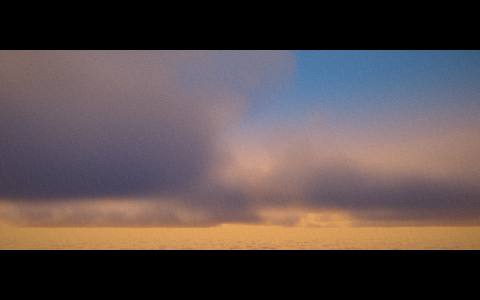
An example in glint, a free live shader editor in the browser: the GLSL code floats over the running picture and recompiles as you type.
The code
3 passes, drawn in this order each frame, in GLSL.
Scene: fragment shader
#version 300 es
precision highp float;

uniform float time;
uniform vec2 resolution;
uniform vec3 spectrum;
uniform float beat;
uniform float beatTime;
uniform int beatCount;
uniform sampler2D fft;
uniform float coverage;

in vec2 v_texcoord;
out vec4 fragColor;

// 1 on each kick, fading; without audio, a steady pulse twice a second.
float kick() { return beatCount > 0 ? beat : pow(1.0 - fract(time * 2.0), 4.0); }
// Seconds since the last kick, and which kick it was (the same fallback).
float sinceKick() { return beatCount > 0 ? beatTime : fract(time * 2.0) / 2.0; }
float kickId() { return beatCount > 0 ? float(beatCount) : floor(time * 2.0); }
// One FFT bin, 0..1 across the spectrum (bass on the left).
float bin(float x) { return texture(fft, vec2(x, 0.25)).r; }
// Is anything playing? (Examples fake their input when not.)
bool silent() { return spectrum.x + spectrum.y + spectrum.z < 0.0001; }

float hash(float n) { return fract(sin(n * 127.1) * 43758.5453); }
float hash(vec2 p) { return fract(sin(dot(p, vec2(127.1, 311.7))) * 43758.5453); }
vec2 hash2(float n) { return fract(sin(vec2(n * 127.1, n * 269.5)) * 43758.5453); }
mat2 rot(float a) { float c = cos(a), s = sin(a); return mat2(c, s, -s, c); }
vec3 pal(float t) { return 0.5 + 0.5 * cos(6.28318 * (t + vec3(0.0, 0.33, 0.67))); }

float hash13(vec3 p) {
    uvec3 q = uvec3(ivec3(floor(p)) + 1000000) * uvec3(1597334673u, 3812015801u, 2798796415u);
    uint n = (q.x ^ q.y ^ q.z) * 1597334673u;
    return float(n >> 8) / 16777216.0;
}
float hash12(vec2 p) {
    uvec2 q = uvec2(ivec2(floor(p)) + 1000000) * uvec2(1597334673u, 3812015801u);
    uint n = (q.x ^ q.y) * 1597334673u;
    return float(n >> 8) / 16777216.0;
}
float noise3(vec3 p) {
    vec3 i = floor(p), f = fract(p);
    f = f * f * (3.0 - 2.0 * f);
    return mix(mix(mix(hash13(i), hash13(i + vec3(1.0, 0.0, 0.0)), f.x), mix(hash13(i + vec3(0.0, 1.0, 0.0)), hash13(i + vec3(1.0, 1.0, 0.0)), f.x), f.y),
               mix(mix(hash13(i + vec3(0.0, 0.0, 1.0)), hash13(i + vec3(1.0, 0.0, 1.0)), f.x), mix(hash13(i + vec3(0.0, 1.0, 1.0)), hash13(i + vec3(1.0, 1.0, 1.0)), f.x), f.y), f.z);
}
float noise2(vec2 p) {
    vec2 i = floor(p), f = fract(p);
    f = f * f * (3.0 - 2.0 * f);
    return mix(mix(hash12(i), hash12(i + vec2(1.0, 0.0)), f.x), mix(hash12(i + vec2(0.0, 1.0)), hash12(i + vec2(1.0, 1.0)), f.x), f.y);
}
float fbm3(vec3 p, int oct) {
    float s = 0.0, a = 0.5;
    for (int i = 0; i < 8; i++) {
        if (i >= oct) break;
        s += a * noise3(p);
        p = p * 2.02 + vec3(13.1, 7.7, 3.3);
        a *= 0.5;
    }
    return s;
}
float fbm2(vec2 p, int oct) {
    float s = 0.0, a = 0.5;
    mat2 m = mat2(1.6, 1.2, -1.2, 1.6);
    for (int i = 0; i < 10; i++) {
        if (i >= oct) break;
        s += a * noise2(p);
        p = m * p;
        a *= 0.5;
    }
    return s;
}
vec3 look(vec3 ro, vec3 ta, vec2 uv, float zoom) {
    vec3 f = normalize(ta - ro), r = normalize(cross(vec3(0.0, 1.0, 0.0), f)), u = cross(f, r);
    return normalize(uv.x * r + uv.y * u + zoom * f);
}
// Henyey-Greenstein: how much light scatters towards the eye (g > 0: mostly forwards).
float hg(float c, float g) { float g2 = g * g; return (1.0 - g2) / (12.566 * pow(1.0 + g2 - 2.0 * g * c, 1.5)); }
// A starfield on directions: three layers of jittered points, warm to cool.
vec3 starfield(vec3 d) {
    vec3 col = vec3(0.0);
    for (int l = 0; l < 3; l++) {
        float sc = 110.0 + float(l) * 160.0;
        vec3 q = d * sc;
        vec3 id = floor(q);
        float h = hash13(id + float(l) * 37.0);
        if (h > 0.982) {
            vec3 j = vec3(hash13(id + 1.3), hash13(id + 2.7), hash13(id + 5.1)) - 0.5;
            float dd = length(fract(q) - 0.5 - j * 0.6);
            col += mix(vec3(1.0, 0.8, 0.6), vec3(0.6, 0.75, 1.0), hash13(id + 9.0)) * exp(-dd * dd * 60.0) * (h - 0.982) * 90.0;
        }
    }
    return col;
}

float bass;

vec3 sunDir() { return normalize(vec3(-0.85, 0.16 + 0.02 * sin(time * 0.05), 0.55)); }

vec3 sky(vec3 rd, vec3 sd) {
    float h = clamp(rd.y, -0.1, 1.0);
    vec3 col = mix(vec3(1.0, 0.6, 0.36), vec3(0.24, 0.38, 0.7), smoothstep(-0.02, 0.4, h));
    col = mix(col, vec3(0.07, 0.11, 0.3), smoothstep(0.4, 1.0, h));
    float s = max(dot(rd, sd), 0.0);
    col += vec3(1.0, 0.5, 0.22) * pow(s, 6.0) * 0.9;
    col += vec3(1.0, 0.85, 0.6) * pow(s, 64.0) * 1.6;
    col += vec3(1.0, 0.95, 0.85) * smoothstep(0.9993, 0.9997, s) * 30.0 * (1.0 + bass);
    return col * 0.6;
}

// Cloud density: a layer from 2.5 to 7.5 up, billowing fbm shaped to flat bottoms and round tops, eroded at the edges.
float cloud(vec3 p) {
    float h = (p.y - 2.5) / 5.0;
    if (h < 0.0 || h > 1.0) return 0.0;
    vec3 q = p * 0.085 + vec3(time * 0.02, 0.0, time * 0.008);
    float profile = smoothstep(0.0, 0.1, h) * smoothstep(1.0, 0.3, h);
    float d = (fbm3(q, 5) - (1.08 - coverage)) * profile;
    if (d <= 0.0) return 0.0;
    d -= (fbm3(q * 5.0 + vec3(0.0, time * 0.05, 0.0), 3) - 0.5) * 0.12;
    return clamp(d * 5.0, 0.0, 1.0);
}

// How much cloud lies between a point and the sun: six steps, longer and longer.
float towardSun(vec3 p, vec3 sd) {
    float od = 0.0, t = 0.15;
    for (int i = 0; i < 6; i++) {
        float dt = t * 0.8;
        od += cloud(p + sd * t) * dt;
        t += dt;
    }
    return od;
}

void main() {
    vec2 uv = (gl_FragCoord.xy - 0.5 * resolution) / resolution.y;
    bass = silent() ? 0.25 + 0.25 * kick() : spectrum.x;
    vec3 sd = sunDir();
    vec3 ro = vec3(time * 0.6, 1.5 + 0.3 * sin(time * 0.1), time * 2.0);
    vec3 rd = look(ro, ro + vec3(0.25 + 0.1 * sin(time * 0.07), 0.22, 1.0), uv, 1.3);
    vec3 col = sky(rd, sd);
    float depth = 1.0;
    if (rd.y < 0.0) {
        // The sea: waves only bend the normal (smoother far away), the sky reflected, the sun glittering.
        float t = -ro.y / rd.y;
        vec3 p = ro + rd * t;
        vec2 w = p.xz * 0.6 + vec2(time * 0.3, time * 0.2);
        float e = 0.04, amp = 0.35 / (1.0 + t * 0.04);
        float hc = fbm2(w, 6);
        vec3 n = normalize(vec3(-(fbm2(w + vec2(e, 0.0), 6) - hc) / e * amp, 1.0, -(fbm2(w + vec2(0.0, e), 6) - hc) / e * amp));
        vec3 r = reflect(rd, n);
        r.y = abs(r.y);
        float fres = 0.02 + 0.98 * pow(1.0 - max(dot(n, -rd), 0.0), 5.0);
        col = mix(vec3(0.01, 0.04, 0.07), sky(r, sd), fres);
        col += vec3(1.0, 0.7, 0.4) * pow(max(dot(r, sd), 0.0), 400.0) * 12.0 * (1.0 + bass);
        col = mix(col, sky(normalize(vec3(rd.x, 0.0, rd.z)), sd), 1.0 - exp(-t * 0.012));
        depth = min(t / 90.0, 1.0);
    } else {
        // Through the cloud layer: light that reached each point from the sun (Beer's law, with the dark edges real
        // clouds have), scattered mostly forwards, plus sky light.
        float t0 = (2.5 - ro.y) / rd.y, t1 = min((7.5 - ro.y) / rd.y, 90.0);
        if (t0 < t1) {
            const int N = 72;
            float dt = (t1 - t0) / float(N);
            float t = t0 + dt * hash(gl_FragCoord.xy + fract(time) * 50.0);
            float mu = dot(rd, sd);
            float phase = mix(hg(mu, 0.6), hg(mu, -0.2), 0.3) * 2.5;
            vec3 acc = vec3(0.0);
            float T = 1.0;
            for (int i = 0; i < N; i++) {
                vec3 p = ro + rd * t;
                float d = cloud(p);
                if (d > 0.01) {
                    float od = towardSun(p, sd);
                    float beer = exp(-od * 2.0), powder = 1.0 - exp(-d * 4.0);
                    vec3 sun = vec3(1.0, 0.72, 0.48) * 1.5 * (1.0 + 0.6 * bass) * beer * powder * phase;
                    vec3 amb = mix(vec3(0.1, 0.12, 0.2), vec3(0.6, 0.48, 0.5), (p.y - 2.5) / 5.0) * 0.6;
                    float a = 1.0 - exp(-d * dt * 1.6);
                    acc += T * a * (sun + amb);
                    T *= 1.0 - a;
                    if (T < 0.02) break;
                }
                t += dt;
            }
            acc = mix(acc, sky(rd, sd) * (1.0 - T), 1.0 - exp(-t0 * 0.012));
            col = col * T + acc;
            if (T < 0.6) depth = min(t0 / 90.0, 1.0);
        }
    }
    fragColor = vec4(col, depth);
}
Bloom: fragment shader
#version 300 es
precision highp float;

uniform sampler2D pass0;
uniform vec2 resolution;

in vec2 v_texcoord;
out vec4 fragColor;

// Glow: only what's brighter than white, gathered on a golden-angle spiral at two sizes (a tight core, a wide haze).
void main() {
    vec2 st = gl_FragCoord.xy / resolution;
    vec2 aspect = vec2(resolution.y / resolution.x, 1.0);
    vec3 tight = vec3(0.0), wide = vec3(0.0);
    for (int i = 0; i < 64; i++) {
        float fi = float(i) + 0.5;
        vec2 dir = vec2(cos(fi * 2.39996), sin(fi * 2.39996)) * sqrt(fi / 64.0) * aspect;
        tight += max(texture(pass0, st + dir * 0.03).rgb - 1.0, 0.0);
        wide += max(texture(pass0, st + dir * 0.12).rgb - 1.0, 0.0);
    }
    fragColor = vec4((tight * 0.6 + wide * 0.4) / 64.0, 1.0);
}
Lens: fragment shader
#version 300 es
precision highp float;

uniform sampler2D pass0;
uniform sampler2D pass1;
uniform vec2 resolution;
uniform float time;
uniform float exposure;
uniform float aperture;

in vec2 v_texcoord;
out vec4 fragColor;

float hash(float n) { return fract(sin(n * 127.1) * 43758.5453); }
float hash(vec2 p) { return fract(sin(dot(p, vec2(127.1, 311.7))) * 43758.5453); }
vec2 hash2(float n) { return fract(sin(vec2(n * 127.1, n * 269.5)) * 43758.5453); }
mat2 rot(float a) { float c = cos(a), s = sin(a); return mat2(c, s, -s, c); }
vec3 pal(float t) { return 0.5 + 0.5 * cos(6.28318 * (t + vec3(0.0, 0.33, 0.67))); }

vec3 aces(vec3 x) { return clamp((x * (2.51 * x + 0.03)) / (x * (2.43 * x + 0.59) + 0.14), 0.0, 1.0); }

void main() {
    vec2 st = gl_FragCoord.xy / resolution;
    vec2 aspect = vec2(resolution.y / resolution.x, 1.0);
    // Cinema bars.
    float bars = abs(st.y - 0.5) * 2.0;
    if (bars > resolution.x / resolution.y / 2.39 * 1.0 && resolution.x > resolution.y) { fragColor = vec4(0.0, 0.0, 0.0, 1.0); return; }

    // Depth of field, focused on whatever's in the middle of the frame (it's usually the orb).
    float focus = texture(pass0, vec2(0.5)).a;
    float depth = texture(pass0, st).a;
    float blur = clamp(abs(depth - focus) / max(depth, 0.01) * 0.005 * aperture, 0.0, 0.008);
    // Chromatic aberration: red and blue land a little apart towards the edges.
    vec2 fromCentre = st - 0.5;
    float ca = 0.004 * dot(fromCentre, fromCentre) * 4.0;
    vec3 col = vec3(0.0);
    float total = 0.0;
    for (int i = 0; i < 48; i++) {
        float fi = float(i) + 0.5;
        vec2 o = vec2(cos(fi * 2.39996), sin(fi * 2.39996)) * sqrt(fi / 48.0) * blur * aspect * 2.0;
        // Don't let sharp foreground bleed into the blur behind it: weight by the sample's own blur.
        vec4 c = texture(pass0, st + o);
        float w = clamp(abs(c.a - focus) / max(c.a, 0.01) * 0.005 * aperture / max(blur, 0.0005), 0.2, 1.0);
        col += vec3(texture(pass0, st + o + fromCentre * ca).r, c.g, texture(pass0, st + o - fromCentre * ca).b) * w;
        total += w;
    }
    col /= total;

    // Bloom, a horizontal streak (anamorphic lens), and ghosts mirrored through the middle (lens flare).
    vec3 bloom = texture(pass1, st).rgb;
    vec3 streak = vec3(0.0);
    for (int i = -12; i <= 12; i++) streak += texture(pass1, st + vec2(float(i) * 0.02, 0.0)).rgb * exp(-abs(float(i)) * 0.2);
    vec3 ghosts = vec3(0.0);
    for (int k = 1; k <= 3; k++) ghosts += texture(pass1, 0.5 - fromCentre * (0.5 + float(k) * 0.35)).rgb * pal(float(k) * 0.3) * 0.25;
    col += bloom * 0.7 + streak * vec3(0.3, 0.5, 1.0) * 0.06 + ghosts * 0.6;

    col = aces(col * exposure);
    col = pow(col, vec3(0.4545));
    // Grade: more contrast and colour, cool shadows and warm highlights (the film look).
    float luma = dot(col, vec3(0.2126, 0.7152, 0.0722));
    col = mix(vec3(luma), col, 1.25);
    col = mix(col, col * col * (3.0 - 2.0 * col), 0.6);
    col *= mix(vec3(0.85, 1.0, 1.1), vec3(1.1, 1.0, 0.85), smoothstep(0.1, 0.7, luma));
    col *= 1.0 - 0.35 * dot(fromCentre, fromCentre) * 2.5;                               // vignette
    col += (hash(gl_FragCoord.xy + fract(time) * 713.0) - 0.5) * 0.035;               // film grain
    fragColor = vec4(col, 1.0);
}
More Showpieces examples
Sanctum · Open ocean · Golden bulb · Event horizon · Storm sea · Crystal caves