Sunken temple
glint · Examples · Tutorials · Gallery
Swimming down the nave of a drowned temple: fluted columns, fallen drums in the sand, caustics rippling over everything, and shafts of light through the water, shadowed by the ruins.
Audio-reactive: it moves with music from a microphone, line-in or a file.
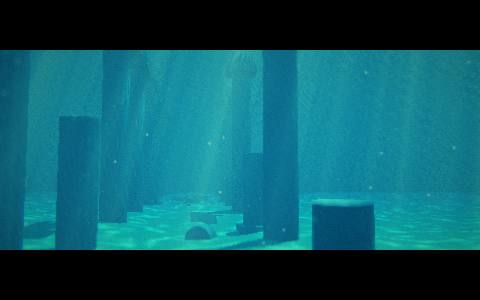
An example in glint, a free live shader editor in the browser: the GLSL code floats over the running picture and recompiles as you type.
The code
3 passes, drawn in this order each frame, in GLSL.
Scene: fragment shader
#version 300 es
precision highp float;

uniform float time;
uniform vec2 resolution;
uniform vec3 spectrum;
uniform float beat;
uniform float beatTime;
uniform int beatCount;
uniform sampler2D fft;
uniform float rays;

in vec2 v_texcoord;
out vec4 fragColor;

// 1 on each kick, fading; without audio, a steady pulse twice a second.
float kick() { return beatCount > 0 ? beat : pow(1.0 - fract(time * 2.0), 4.0); }
// Seconds since the last kick, and which kick it was (the same fallback).
float sinceKick() { return beatCount > 0 ? beatTime : fract(time * 2.0) / 2.0; }
float kickId() { return beatCount > 0 ? float(beatCount) : floor(time * 2.0); }
// One FFT bin, 0..1 across the spectrum (bass on the left).
float bin(float x) { return texture(fft, vec2(x, 0.25)).r; }
// Is anything playing? (Examples fake their input when not.)
bool silent() { return spectrum.x + spectrum.y + spectrum.z < 0.0001; }

float hash(float n) { return fract(sin(n * 127.1) * 43758.5453); }
float hash(vec2 p) { return fract(sin(dot(p, vec2(127.1, 311.7))) * 43758.5453); }
vec2 hash2(float n) { return fract(sin(vec2(n * 127.1, n * 269.5)) * 43758.5453); }
mat2 rot(float a) { float c = cos(a), s = sin(a); return mat2(c, s, -s, c); }
vec3 pal(float t) { return 0.5 + 0.5 * cos(6.28318 * (t + vec3(0.0, 0.33, 0.67))); }

float hash13(vec3 p) {
    uvec3 q = uvec3(ivec3(floor(p)) + 1000000) * uvec3(1597334673u, 3812015801u, 2798796415u);
    uint n = (q.x ^ q.y ^ q.z) * 1597334673u;
    return float(n >> 8) / 16777216.0;
}
float hash12(vec2 p) {
    uvec2 q = uvec2(ivec2(floor(p)) + 1000000) * uvec2(1597334673u, 3812015801u);
    uint n = (q.x ^ q.y) * 1597334673u;
    return float(n >> 8) / 16777216.0;
}
float noise3(vec3 p) {
    vec3 i = floor(p), f = fract(p);
    f = f * f * (3.0 - 2.0 * f);
    return mix(mix(mix(hash13(i), hash13(i + vec3(1.0, 0.0, 0.0)), f.x), mix(hash13(i + vec3(0.0, 1.0, 0.0)), hash13(i + vec3(1.0, 1.0, 0.0)), f.x), f.y),
               mix(mix(hash13(i + vec3(0.0, 0.0, 1.0)), hash13(i + vec3(1.0, 0.0, 1.0)), f.x), mix(hash13(i + vec3(0.0, 1.0, 1.0)), hash13(i + vec3(1.0, 1.0, 1.0)), f.x), f.y), f.z);
}
float noise2(vec2 p) {
    vec2 i = floor(p), f = fract(p);
    f = f * f * (3.0 - 2.0 * f);
    return mix(mix(hash12(i), hash12(i + vec2(1.0, 0.0)), f.x), mix(hash12(i + vec2(0.0, 1.0)), hash12(i + vec2(1.0, 1.0)), f.x), f.y);
}
float fbm3(vec3 p, int oct) {
    float s = 0.0, a = 0.5;
    for (int i = 0; i < 8; i++) {
        if (i >= oct) break;
        s += a * noise3(p);
        p = p * 2.02 + vec3(13.1, 7.7, 3.3);
        a *= 0.5;
    }
    return s;
}
float fbm2(vec2 p, int oct) {
    float s = 0.0, a = 0.5;
    mat2 m = mat2(1.6, 1.2, -1.2, 1.6);
    for (int i = 0; i < 10; i++) {
        if (i >= oct) break;
        s += a * noise2(p);
        p = m * p;
        a *= 0.5;
    }
    return s;
}
vec3 look(vec3 ro, vec3 ta, vec2 uv, float zoom) {
    vec3 f = normalize(ta - ro), r = normalize(cross(vec3(0.0, 1.0, 0.0), f)), u = cross(f, r);
    return normalize(uv.x * r + uv.y * u + zoom * f);
}
// Henyey-Greenstein: how much light scatters towards the eye (g > 0: mostly forwards).
float hg(float c, float g) { float g2 = g * g; return (1.0 - g2) / (12.566 * pow(1.0 + g2 - 2.0 * g * c, 1.5)); }
// A starfield on directions: three layers of jittered points, warm to cool.
vec3 starfield(vec3 d) {
    vec3 col = vec3(0.0);
    for (int l = 0; l < 3; l++) {
        float sc = 110.0 + float(l) * 160.0;
        vec3 q = d * sc;
        vec3 id = floor(q);
        float h = hash13(id + float(l) * 37.0);
        if (h > 0.982) {
            vec3 j = vec3(hash13(id + 1.3), hash13(id + 2.7), hash13(id + 5.1)) - 0.5;
            float dd = length(fract(q) - 0.5 - j * 0.6);
            col += mix(vec3(1.0, 0.8, 0.6), vec3(0.6, 0.75, 1.0), hash13(id + 9.0)) * exp(-dd * dd * 60.0) * (h - 0.982) * 90.0;
        }
    }
    return col;
}

float bass;

const vec3 LIGHT = normalize(vec3(0.25, 1.0, 0.15));
const float SURFACE = 14.0;

float sdBox(vec3 p, vec3 b) { vec3 q = abs(p) - b; return length(max(q, 0.0)) + min(max(q.x, max(q.y, q.z)), 0.0); }

// Two rows of fluted columns down the nave, some broken off, some with their capital, lintels where both stand, and
// fallen drums in the sand.
vec2 map(vec3 p) {
    float sand = p.y - (fbm2(p.xz * 0.15, 4) * 1.2 + sin(p.x * 1.5 + sin(p.z * 0.7)) * 0.05);
    vec2 res = vec2(sand, 1.0);
    float cell = 5.0;
    float k = floor(p.z / cell + 0.5);
    vec3 q = vec3(abs(p.x) - 3.2, p.y, p.z - k * cell);
    float id = k * 2.0 + step(0.0, p.x);
    float hgt = hash(id * 3.7) < 0.3 ? 2.0 + 3.0 * hash(id * 1.3) : 9.0;
    float ang = atan(q.z, q.x);
    float r = 0.55 + 0.025 * smoothstep(-0.2, 0.2, sin(ang * 16.0));
    float col = max(length(q.xz) - r, abs(q.y - hgt * 0.5) - hgt * 0.5);
    col = min(col, sdBox(q - vec3(0.0, 0.25, 0.0), vec3(0.8, 0.25, 0.8)));
    if (hgt > 8.0) col = min(col, sdBox(q - vec3(0.0, hgt + 0.3, 0.0), vec3(0.85, 0.3, 0.85)));
    if (col < res.x) res = vec2(col, 2.0);
    // A lintel across the top when this column is whole (it reaches over the aisle).
    if (hgt > 8.0) {
        float lin = sdBox(vec3(q.x, p.y - hgt - 0.9, q.z + cell * 0.5), vec3(0.6, 0.4, cell * 0.5 + 0.6));
        if (lin < res.x) res = vec2(lin, 2.0);
    }
    // A fallen drum lying in the aisle.
    vec3 f = vec3(p.x - (hash(k * 5.1) - 0.5) * 2.5, p.y - 0.4, p.z - k * cell - 2.5);
    f.xz = rot(hash(k * 2.9) * 3.0) * f.xz;
    float drum = max(length(f.yz) - 0.5, abs(f.x) - 0.6);
    if (hash(k * 8.3) > 0.4 && drum < res.x) res = vec2(drum, 2.0);
    return res;
}

vec3 normal(vec3 p) {
    vec2 e = vec2(0.003, 0.0);
    return normalize(vec3(map(p + e.xyy).x - map(p - e.xyy).x, map(p + e.yxy).x - map(p - e.yxy).x, map(p + e.yyx).x - map(p - e.yyx).x));
}

// Caustics: the bright web of light focused by the waves above.
float caustic(vec2 p) {
    vec2 q = p * 0.7;
    float c = 0.0;
    for (int i = 0; i < 3; i++) {
        q = rot(1.3) * q * 1.6 + vec2(time * 0.17, time * 0.11);
        c += abs(sin(q.x + sin(q.y * 1.3 + time * 0.4)) * sin(q.y + sin(q.x * 0.7 - time * 0.3)));
    }
    return pow(1.0 - c / 3.0, 7.0) * 6.0;
}

float sunShadow(vec3 p) {
    float t = 0.05;
    for (int i = 0; i < 20; i++) {
        float d = map(p + LIGHT * t).x;
        if (d < 0.002) return 0.0;
        t += max(d, 0.15);
        if (p.y + LIGHT.y * t > SURFACE) break;
    }
    return 1.0;
}

// Light reaching a point from the surface: caustics projected down the light's direction, through the water.
float sunlight(vec3 p) {
    vec2 at = p.xz + LIGHT.xz / LIGHT.y * (SURFACE - p.y);
    return caustic(at) * exp(-(SURFACE - p.y) * 0.06);
}

void main() {
    vec2 uv = (gl_FragCoord.xy - 0.5 * resolution) / resolution.y;
    bass = silent() ? 0.2 + 0.2 * kick() : spectrum.x;
    vec3 ro = vec3(sin(time * 0.1) * 1.0, 2.6 + 0.5 * sin(time * 0.13), time * 0.9);
    vec3 rd = look(ro, ro + vec3(sin(time * 0.07) * 0.5, 0.05 + 0.1 * sin(time * 0.05), 1.0), uv, 1.2);
    float t = 0.05;
    vec2 h = vec2(0.0);
    for (int i = 0; i < 160; i++) {
        h = map(ro + rd * t);
        if (h.x < 0.001 * t) break;
        t += h.x * 0.8;
        if (t > 45.0) { h.y = 0.0; break; }
    }
    vec3 water = vec3(0.02, 0.18, 0.25);
    vec3 col = water * (0.5 + 0.8 * max(rd.y, 0.0));
    if (h.y > 0.5) {
        vec3 p = ro + rd * t;
        vec3 n = normal(p);
        vec3 alb = h.y < 1.5 ? vec3(0.75, 0.68, 0.5) : vec3(0.62, 0.6, 0.55) * (0.7 + 0.3 * fbm3(p * 3.0, 3));
        float dif = max(dot(n, LIGHT), 0.0) * sunShadow(p + n * 0.02);
        float occ = clamp(0.5 + 0.5 * n.y, 0.0, 1.0);
        col = alb * (vec3(0.6, 0.9, 1.0) * dif * (0.5 + sunlight(p)) * (1.0 + 0.6 * bass) + water * occ * 1.2);
    }
    // Absorption: red goes first, then green.
    col *= exp(-t * vec3(0.22, 0.07, 0.045));
    col += water * (1.0 - exp(-t * 0.06)) * 0.8;
    // Shafts of light: march the ray through the water, sampling the caustic light and the shadows of the ruins.
    float steps = 48.0;
    float dt = min(t, 40.0) / steps;
    float s = dt * hash(gl_FragCoord.xy + fract(time) * 17.0);
    vec3 shafts = vec3(0.0);
    for (int i = 0; i < 48; i++) {
        vec3 q = ro + rd * s;
        float l = sunlight(q) * sunShadow(q);
        shafts += vec3(0.35, 0.75, 0.85) * l * exp(-s * 0.08) * dt;
        s += dt;
    }
    float phase = 0.5 + 1.5 * pow(max(dot(rd, LIGHT), 0.0), 4.0);
    col += shafts * 0.05 * rays * phase;
    // Marine snow drifting past.
    for (int l = 0; l < 3; l++) {
        float sc = 6.0 + float(l) * 5.0;
        vec2 g = uv * sc + vec2(sin(time * 0.2 + float(l)) * 0.5, time * (0.15 + 0.05 * float(l)));
        vec2 id = floor(g);
        vec2 c = vec2(hash(id), hash(id + 7.0));
        float d = length(fract(g) - c);
        col += vec3(0.6, 0.8, 0.8) * smoothstep(0.04, 0.0, d) * step(0.6, hash(id + 3.0)) * 0.25 / (1.0 + float(l));
    }
    fragColor = vec4(col, min(t / 45.0, 1.0));
}
Bloom: fragment shader
#version 300 es
precision highp float;

uniform sampler2D pass0;
uniform vec2 resolution;

in vec2 v_texcoord;
out vec4 fragColor;

// Glow: only what's brighter than white, gathered on a golden-angle spiral at two sizes (a tight core, a wide haze).
void main() {
    vec2 st = gl_FragCoord.xy / resolution;
    vec2 aspect = vec2(resolution.y / resolution.x, 1.0);
    vec3 tight = vec3(0.0), wide = vec3(0.0);
    for (int i = 0; i < 64; i++) {
        float fi = float(i) + 0.5;
        vec2 dir = vec2(cos(fi * 2.39996), sin(fi * 2.39996)) * sqrt(fi / 64.0) * aspect;
        tight += max(texture(pass0, st + dir * 0.03).rgb - 1.0, 0.0);
        wide += max(texture(pass0, st + dir * 0.12).rgb - 1.0, 0.0);
    }
    fragColor = vec4((tight * 0.6 + wide * 0.4) / 64.0, 1.0);
}
Lens: fragment shader
#version 300 es
precision highp float;

uniform sampler2D pass0;
uniform sampler2D pass1;
uniform vec2 resolution;
uniform float time;
uniform float exposure;
uniform float aperture;

in vec2 v_texcoord;
out vec4 fragColor;

float hash(float n) { return fract(sin(n * 127.1) * 43758.5453); }
float hash(vec2 p) { return fract(sin(dot(p, vec2(127.1, 311.7))) * 43758.5453); }
vec2 hash2(float n) { return fract(sin(vec2(n * 127.1, n * 269.5)) * 43758.5453); }
mat2 rot(float a) { float c = cos(a), s = sin(a); return mat2(c, s, -s, c); }
vec3 pal(float t) { return 0.5 + 0.5 * cos(6.28318 * (t + vec3(0.0, 0.33, 0.67))); }

vec3 aces(vec3 x) { return clamp((x * (2.51 * x + 0.03)) / (x * (2.43 * x + 0.59) + 0.14), 0.0, 1.0); }

void main() {
    vec2 st = gl_FragCoord.xy / resolution;
    vec2 aspect = vec2(resolution.y / resolution.x, 1.0);
    // Cinema bars.
    float bars = abs(st.y - 0.5) * 2.0;
    if (bars > resolution.x / resolution.y / 2.39 * 1.0 && resolution.x > resolution.y) { fragColor = vec4(0.0, 0.0, 0.0, 1.0); return; }

    // Depth of field, focused on whatever's in the middle of the frame (it's usually the orb).
    float focus = texture(pass0, vec2(0.5)).a;
    float depth = texture(pass0, st).a;
    float blur = clamp(abs(depth - focus) / max(depth, 0.01) * 0.005 * aperture, 0.0, 0.008);
    // Chromatic aberration: red and blue land a little apart towards the edges.
    vec2 fromCentre = st - 0.5;
    float ca = 0.004 * dot(fromCentre, fromCentre) * 4.0;
    vec3 col = vec3(0.0);
    float total = 0.0;
    for (int i = 0; i < 48; i++) {
        float fi = float(i) + 0.5;
        vec2 o = vec2(cos(fi * 2.39996), sin(fi * 2.39996)) * sqrt(fi / 48.0) * blur * aspect * 2.0;
        // Don't let sharp foreground bleed into the blur behind it: weight by the sample's own blur.
        vec4 c = texture(pass0, st + o);
        float w = clamp(abs(c.a - focus) / max(c.a, 0.01) * 0.005 * aperture / max(blur, 0.0005), 0.2, 1.0);
        col += vec3(texture(pass0, st + o + fromCentre * ca).r, c.g, texture(pass0, st + o - fromCentre * ca).b) * w;
        total += w;
    }
    col /= total;

    // Bloom, a horizontal streak (anamorphic lens), and ghosts mirrored through the middle (lens flare).
    vec3 bloom = texture(pass1, st).rgb;
    vec3 streak = vec3(0.0);
    for (int i = -12; i <= 12; i++) streak += texture(pass1, st + vec2(float(i) * 0.02, 0.0)).rgb * exp(-abs(float(i)) * 0.2);
    vec3 ghosts = vec3(0.0);
    for (int k = 1; k <= 3; k++) ghosts += texture(pass1, 0.5 - fromCentre * (0.5 + float(k) * 0.35)).rgb * pal(float(k) * 0.3) * 0.25;
    col += bloom * 0.7 + streak * vec3(0.3, 0.5, 1.0) * 0.06 + ghosts * 0.6;

    col = aces(col * exposure);
    col = pow(col, vec3(0.4545));
    // Grade: more contrast and colour, cool shadows and warm highlights (the film look).
    float luma = dot(col, vec3(0.2126, 0.7152, 0.0722));
    col = mix(vec3(luma), col, 1.25);
    col = mix(col, col * col * (3.0 - 2.0 * col), 0.6);
    col *= mix(vec3(0.85, 1.0, 1.1), vec3(1.1, 1.0, 0.85), smoothstep(0.1, 0.7, luma));
    col *= 1.0 - 0.35 * dot(fromCentre, fromCentre) * 2.5;                               // vignette
    col += (hash(gl_FragCoord.xy + fract(time) * 713.0) - 0.5) * 0.035;               // film grain
    fragColor = vec4(col, 1.0);
}
More Showpieces examples
Nebula · Neon rain · Aurora lake · Golden dunes · Ringed world · Gasket lantern · Lava world · Deep glow