Neon pinball
glint · Examples · Tutorials · Gallery
A neon pinball table seen from above: the ball ricocheting between bumpers that light up as it passes, the flippers snapping on every kick.
Audio-reactive: it moves with music from a microphone, line-in or a file.
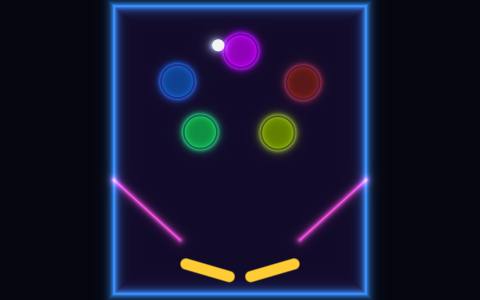
An example in glint, a free live shader editor in the browser: the GLSL code floats over the running picture and recompiles as you type.
The code
One pass, in GLSL.
fragment shader
#version 300 es
precision highp float;

uniform float time;
uniform vec2 resolution;
uniform vec3 spectrum;
uniform float beat;
uniform float beatTime;
uniform int beatCount;
uniform sampler2D fft;
uniform float bpm;
uniform float beatPhase;
uniform float barPhase;

in vec2 v_texcoord;
out vec4 fragColor;

#define PI 3.14159265
// 1 on each kick, fading; without audio, a steady pulse twice a second.
float kick() { return beatCount > 0 ? beat : pow(1.0 - fract(time * 2.0), 4.0); }
float sinceKick() { return beatCount > 0 ? beatTime : fract(time * 2.0) / 2.0; }
float kickId() { return beatCount > 0 ? float(beatCount) : floor(time * 2.0); }
float bin(float x) { return texture(fft, vec2(clamp(x, 0.0, 1.0), 0.25)).r; }
// With no sound in, gentle stand-ins so a visual is never empty: a moving spectrum, a bass that follows the pulse.
float silent() { return step(spectrum.x + spectrum.y + spectrum.z, 0.02); }
float level(float x) { return mix(bin(x), 0.3 + 0.25 * sin(time * 2.3 + x * 17.0) * sin(time * 1.1 + x * 5.0) + 0.15 * kick(), silent()); }
float bass() { return mix(spectrum.x, 0.15 + 0.25 * kick(), silent()); }
float hash(float n) { return fract(sin(n * 127.1) * 43758.5453); }
float hash(vec2 p) { return fract(sin(dot(p, vec2(127.1, 311.7))) * 43758.5453); }
vec2 hash2(vec2 p) { return fract(sin(vec2(dot(p, vec2(127.1, 311.7)), dot(p, vec2(269.5, 183.3)))) * 43758.5453); }
mat2 rot(float a) { float c = cos(a), s = sin(a); return mat2(c, s, -s, c); }
vec3 pal(float t) { return 0.5 + 0.5 * cos(6.28318 * (t + vec3(0.0, 0.33, 0.67))); }
float noise(vec2 p) {
    vec2 i = floor(p), f = fract(p);
    f = f * f * (3.0 - 2.0 * f);
    return mix(mix(hash(i), hash(i + vec2(1.0, 0.0)), f.x), mix(hash(i + vec2(0.0, 1.0)), hash(i + vec2(1.0, 1.0)), f.x), f.y);
}
float fbm(vec2 p) {
    float v = 0.0, a = 0.5;
    for (int i = 0; i < 5; i++) { v += a * noise(p); p = rot(0.5) * p * 2.02; a *= 0.5; }
    return v;
}

float seg(vec2 p, vec2 a, vec2 b) { vec2 pa = p - a, ba = b - a; float h = clamp(dot(pa, ba) / dot(ba, ba), 0.0, 1.0); return length(pa - ba * h); }
void main() {
    vec2 uv = (gl_FragCoord.xy - 0.5 * resolution) / resolution.y;
    vec3 col = vec3(0.02, 0.02, 0.06);
    vec2 p = uv * vec2(1.0, 1.0);
    // The table's edge.
    float table = abs(max(abs(p.x) - 0.42, abs(p.y) - 0.48));
    col += vec3(0.2, 0.6, 1.0) * exp(-table * 80.0);
    col += vec3(0.05, 0.02, 0.1) * step(abs(p.x), 0.42) * step(abs(p.y), 0.48);
    // The ball, on a looping path.
    vec2 ball = vec2(0.33 * sin(time * 1.3) * cos(time * 0.37), 0.3 * sin(time * 1.9 + 1.0) + 0.05);
    // Bumpers light when the ball is near, and on the kick.
    for (int i = 0; i < 5; i++) {
        float fi = float(i);
        vec2 c = vec2(0.22 * cos(fi * 1.256 + 0.3), 0.18 + 0.15 * sin(fi * 1.256 + 0.3));
        float near = exp(-length(ball - c) * 10.0);
        float lit = max(near, kick() * step(hash(fi + kickId()), 0.5));
        float d = length(p - c);
        vec3 hue = pal(fi / 5.0);
        col = mix(col, hue * (0.3 + 1.2 * lit), smoothstep(0.055, 0.05, d));
        col += hue * exp(-abs(d - 0.06) * 120.0) * (0.4 + lit);
    }
    // Lanes and slingshots.
    col += vec3(1.0, 0.3, 0.8) * exp(-seg(p, vec2(-0.42, -0.1), vec2(-0.2, -0.3)) * 120.0);
    col += vec3(1.0, 0.3, 0.8) * exp(-seg(p, vec2(0.42, -0.1), vec2(0.2, -0.3)) * 120.0);
    // Flippers: up on the kick.
    float f = kick();
    vec2 l0 = vec2(-0.18, -0.38), r0 = vec2(0.18, -0.38);
    vec2 l1 = l0 + 0.15 * vec2(cos(-0.5 + f * 0.9), sin(-0.5 + f * 0.9));
    vec2 r1 = r0 + 0.15 * vec2(-cos(-0.5 + f * 0.9), sin(-0.5 + f * 0.9));
    col = mix(col, vec3(1.0, 0.8, 0.2), smoothstep(0.022, 0.015, min(seg(p, l0, l1), seg(p, r0, r1))));
    // The ball, with a trail.
    for (int k = 0; k < 8; k++) {
        float tk = time - float(k) * 0.02;
        vec2 b = vec2(0.33 * sin(tk * 1.3) * cos(tk * 0.37), 0.3 * sin(tk * 1.9 + 1.0) + 0.05);
        col += vec3(0.8, 0.9, 1.0) * exp(-length(p - b) * 90.0) * (1.0 - float(k) / 8.0) * 0.6;
    }
    col = mix(col, vec3(0.95), smoothstep(0.022, 0.018, length(p - ball)));
    fragColor = vec4(col, 1.0);
}
More DJ visuals examples
Flappy beat · Side-scroller shooter · Desert runner · Arcade cabinets · Neon pyramid · VHS tracking · Laser horizon · CRT colour bars