Breakbeat blocks
glint · Examples · Tutorials · Gallery
A grid of bright blocks chopped up and shuffled like a breakbeat, rows and columns sliding to new places on every beat.
Audio-reactive: it moves with music from a microphone, line-in or a file.
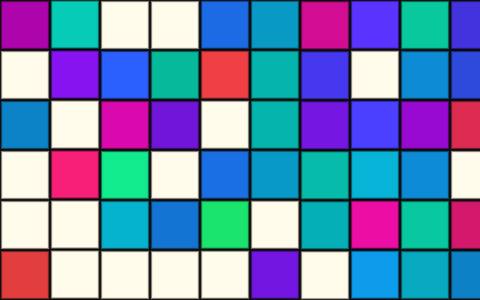
An example in glint, a free live shader editor in the browser: the GLSL code floats over the running picture and recompiles as you type.
The code
One pass, in GLSL.
fragment shader
#version 300 es
precision highp float;

uniform float time;
uniform vec2 resolution;
uniform vec3 spectrum;
uniform float beat;
uniform float beatTime;
uniform int beatCount;
uniform sampler2D fft;
uniform float bpm;
uniform float beatPhase;
uniform float barPhase;

in vec2 v_texcoord;
out vec4 fragColor;

#define PI 3.14159265
// 1 on each kick, fading; without audio, a steady pulse twice a second.
float kick() { return beatCount > 0 ? beat : pow(1.0 - fract(time * 2.0), 4.0); }
float sinceKick() { return beatCount > 0 ? beatTime : fract(time * 2.0) / 2.0; }
float kickId() { return beatCount > 0 ? float(beatCount) : floor(time * 2.0); }
float bin(float x) { return texture(fft, vec2(clamp(x, 0.0, 1.0), 0.25)).r; }
// With no sound in, gentle stand-ins so a visual is never empty: a moving spectrum, a bass that follows the pulse.
float silent() { return step(spectrum.x + spectrum.y + spectrum.z, 0.02); }
float level(float x) { return mix(bin(x), 0.3 + 0.25 * sin(time * 2.3 + x * 17.0) * sin(time * 1.1 + x * 5.0) + 0.15 * kick(), silent()); }
float bass() { return mix(spectrum.x, 0.15 + 0.25 * kick(), silent()); }
float hash(float n) { return fract(sin(n * 127.1) * 43758.5453); }
float hash(vec2 p) { return fract(sin(dot(p, vec2(127.1, 311.7))) * 43758.5453); }
vec2 hash2(vec2 p) { return fract(sin(vec2(dot(p, vec2(127.1, 311.7)), dot(p, vec2(269.5, 183.3)))) * 43758.5453); }
mat2 rot(float a) { float c = cos(a), s = sin(a); return mat2(c, s, -s, c); }
vec3 pal(float t) { return 0.5 + 0.5 * cos(6.28318 * (t + vec3(0.0, 0.33, 0.67))); }
float noise(vec2 p) {
    vec2 i = floor(p), f = fract(p);
    f = f * f * (3.0 - 2.0 * f);
    return mix(mix(hash(i), hash(i + vec2(1.0, 0.0)), f.x), mix(hash(i + vec2(0.0, 1.0)), hash(i + vec2(1.0, 1.0)), f.x), f.y);
}
float fbm(vec2 p) {
    float v = 0.0, a = 0.5;
    for (int i = 0; i < 5; i++) { v += a * noise(p); p = rot(0.5) * p * 2.02; a *= 0.5; }
    return v;
}

float hh(float p) { p = fract(p * 0.1031); p *= p + 33.33; p *= p + p; return fract(p); }
float hh(vec2 p) { vec3 q = fract(vec3(p.xyx) * 0.1031); q += dot(q, q.yzx + 33.33); return fract((q.x + q.y) * q.z); }
vec2 hh2(vec2 p) { vec3 q = fract(vec3(p.xyx) * vec3(0.1031, 0.103, 0.0973)); q += dot(q, q.yzx + 33.33); return fract((q.xx + q.yz) * q.zy); }

float beatDur() { return beatCount > 0 && bpm > 1.0 ? 60.0 / bpm : 0.5; }

void main() {
    vec2 st = gl_FragCoord.xy / resolution;
    float ar = resolution.x / resolution.y;
    vec2 p = vec2(st.x * ar, st.y) * 6.0;
    float k = kickId();
    float prog = 1.0 - pow(1.0 - clamp(sinceKick() / beatDur() * 2.5, 0.0, 1.0), 3.0);
    bool rows = mod(k, 2.0) < 1.0;
    float line = rows ? floor(p.y) : floor(p.x);
    float shift = (floor(hh(vec2(line, k)) * 5.0) - 2.0);
    if (rows) p.x += shift * prog; else p.y += shift * prog;
    vec2 id = floor(p), f = fract(p);
    vec3 col = pal(hh(id) * 0.6 + floor(k / 8.0) * 0.13) * (0.8 + 0.4 * level(fract(id.x * 0.1)));
    if (hh(id * 3.0) > 0.7) col = vec3(1.0, 0.97, 0.9);
    float e = min(min(f.x, f.y), min(1.0 - f.x, 1.0 - f.y));
    col *= smoothstep(0.0, 0.06, e);
    col += vec3(1.0) * kick() * 0.1;
    fragColor = vec4(col, 1.0);
}
More DJ visuals examples
Beach balls · Fist pumps · Rush grid · Tracers · Lightning tunnel · Chase lights · Bass scope · Rapid rings