Bar clock
glint · Examples · Tutorials · Gallery
The tempo uniforms made visible: four quarters light up with the beat in the bar (bar), a ring fills through the bar (barPhase), and the centre pulses on every beat (beatPhase).
Audio-reactive: it moves with music from a microphone, line-in or a file.
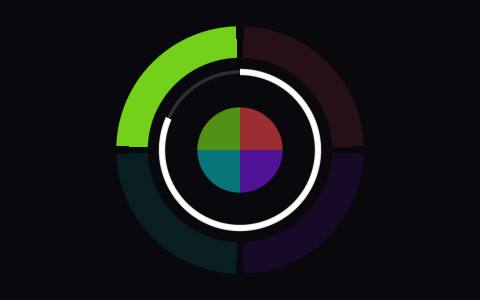
An example in glint, a free live shader editor in the browser: the GLSL code floats over the running picture and recompiles as you type.
The code
One pass, in GLSL.
fragment shader
#version 300 es
precision highp float;

uniform float time;
uniform vec2 resolution;
uniform vec3 spectrum;
uniform float beat;
uniform float beatTime;
uniform int beatCount;
uniform sampler2D fft;
uniform int bar;
uniform float beatPhase;
uniform float barPhase;
uniform float bpm;

in vec2 v_texcoord;
out vec4 fragColor;

// 1 on each kick, fading; without audio, a steady pulse twice a second.
float kick() { return beatCount > 0 ? beat : pow(1.0 - fract(time * 2.0), 4.0); }
// Seconds since the last kick, and which kick it was (the same fallback).
float sinceKick() { return beatCount > 0 ? beatTime : fract(time * 2.0) / 2.0; }
float kickId() { return beatCount > 0 ? float(beatCount) : floor(time * 2.0); }
// One FFT bin, 0..1 across the spectrum (bass on the left).
float bin(float x) { return texture(fft, vec2(x, 0.25)).r; }
// Is anything playing? (Examples fake their input when not.)
bool silent() { return spectrum.x + spectrum.y + spectrum.z < 0.0001; }

float hash(float n) { return fract(sin(n * 127.1) * 43758.5453); }
float hash(vec2 p) { return fract(sin(dot(p, vec2(127.1, 311.7))) * 43758.5453); }
vec2 hash2(float n) { return fract(sin(vec2(n * 127.1, n * 269.5)) * 43758.5453); }
mat2 rot(float a) { float c = cos(a), s = sin(a); return mat2(c, s, -s, c); }
vec3 pal(float t) { return 0.5 + 0.5 * cos(6.28318 * (t + vec3(0.0, 0.33, 0.67))); }

void main() {
    vec2 uv = (gl_FragCoord.xy - 0.5 * resolution) / resolution.y;
    // Without music, a steady 120 BPM.
    bool live = beatCount > 0;
    float phase = live ? beatPhase : fract(time * 2.0);
    float barP = live ? barPhase : fract(time * 0.5);
    int b = live ? bar : int(mod(floor(time * 2.0), 4.0));
    float px = 1.5 / resolution.y;
    float r = length(uv), a = fract(0.25 - atan(uv.y, uv.x) / 6.28318);    // clockwise from twelve
    vec3 col = vec3(0.03, 0.03, 0.05);
    // Four quarters: the current one lit, fading through the beat.
    int q = int(floor(a * 4.0));
    float gap = step(0.02, fract(a * 4.0)) * step(fract(a * 4.0), 0.98);
    float ring = smoothstep(px, 0.0, abs(r - 0.36) - 0.05) * gap;
    vec3 qc = pal(float(q) * 0.25);
    col += qc * ring * (q == b ? 1.0 - 0.6 * phase : 0.12);
    // Progress through the bar.
    col += vec3(0.9) * smoothstep(px, 0.0, abs(r - 0.26) - 0.008) * step(a, barP);
    col += vec3(0.15) * smoothstep(px, 0.0, abs(r - 0.26) - 0.003);
    // The beat.
    float pulse = pow(1.0 - phase, 3.0);
    col += qc * smoothstep(0.12 + 0.05 * pulse + px, 0.12 + 0.05 * pulse, r) * (0.3 + 0.7 * pulse);
    fragColor = vec4(col, 1.0);
}
More Audio-reactive examples
Ring tunnel · Light curtain · Halftone spectrum · Orbitals · Bass snake · Spectrum landscape · Rising bubbles · Op art